


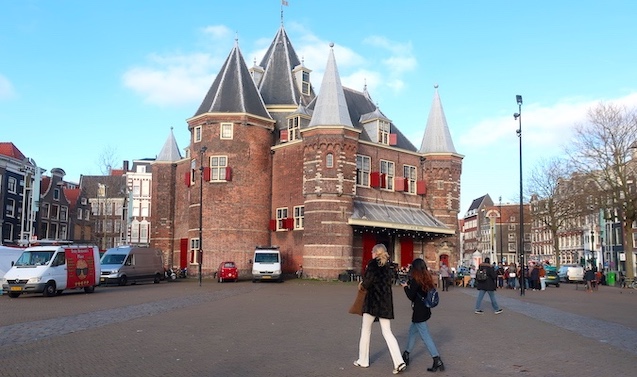
The Waag
The Waag in Amsterdam on Nieuwmarkt Square
De Waag Amsterdam is one of the most important historic buildings in the city centre. It stands on Nieuwmarkt Square and tells the story of Amsterdam’s growth from a walled town into a major trading city.
If you want the direct answer, here it is: Waag Amsterdam began as St. Anthony’s Gate, later became a weigh house, and is now one of the best-known landmarks in the old city. It is widely seen as Amsterdam’s oldest non-religious building.
Last updated: 31 March 2026
DOWNLOAD AMSTERDAM APP“The history of De Waag started when the small city of Amsterdam needed to expand in eastern direction. It looks like a small castle, but de Waag used to be a city gate. In medieval times, it used to be a wooden structure.”
— Jerzy Gawronski, city archaeologist
Quick Facts About The Waag
The Waag is not just a pretty old building. It had many roles over the centuries, including city gate, weigh house, guild building, anatomy theatre, archive, museum, and today a public landmark with a restaurant on the ground floor.
| Quick fact | Answer |
|---|---|
| Name | The Waag |
| Original name | St. Anthony’s Gate |
| Location | Nieuwmarkt Square, Amsterdam |
| First recorded mention | 1466 |
| Best known for | Oldest non-religious building in Amsterdam |
| Current public use | Restaurant on the ground floor, cultural and innovation use above |
- Best for: history lovers, photographers, and first-time Amsterdam visitors
- Nearest area: Nieuwmarkt and the eastern side of the old centre
- Why it matters: it helps explain how medieval Amsterdam worked
- Easy visit: combine it with Zeedijk, Geldersekade, Chinatown, and the Red Light District

Overview of the Building
The Waag | 1466
The Waag was formerly known as the St. Anthony’s Gate. It’s the oldest non-religious building in Amsterdam. The gate is first referred to in a deed in 1466. However, it is quite possible that it is even older.
The outer canal, the current Geldersekade and Kloveniersburgwal, along which the gate was built, was dug during the 1425 expansion of the city. That means the building started on the edge of Amsterdam, not in the middle of it.
Definition: a city gate was a controlled entrance in the city wall. It was used for defense, movement, and supervision of who or what entered the city.
This is why The Waag still looks like a small fortress. The thick walls, towers, and compact shape were built for protection, not decoration. Once you know that, the building makes much more sense.

Made by Frisius, S., Visscher, Claes Jansz (1587-1652) around the year 1600.
The fifteenth-century St Anthony’s Gate had a defensive function. It was a simple gate with walls that were nearly two metres thick and had four towers on the city side were narrow and low; the two broad towers on the canal side had battlements. This oldest part of the city gate is called the main gate.
Addition of the front gate | 1488
The tower on the corner of the Zeedijk and the Geldersekade (The Masons Tower) has a stone tablet that memorializes the “laying of the first stone” in 1488. Contrary to what was long believed, this most likely concerns the expansion of the main gate through the addition of the so-called front gate.

In order to do this, the water in the canals was covered over with a brick arch. This culvert was known as the Bijleveld sluice. Small boats could thus sail through the front gate to the other side of the city canal.
The front gate consisted of a walled courtyard above the sluice, with two towers on the corners. In simple words, it was both a gate and a water-linked checkpoint.
How The Waag Became Part of Nieuwmarkt
City wall demolished | 1600
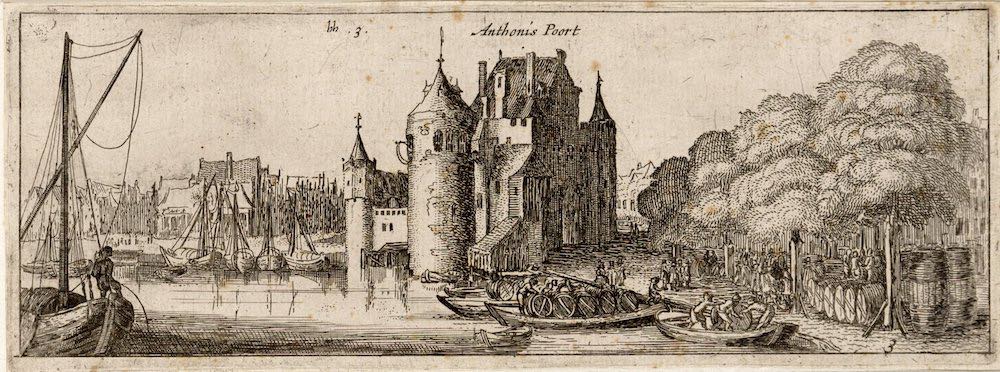
El el Nieuwmarkt in 1609.
At the end of the sixteenth century, Amsterdam underwent two urban expansions. A new defensive work was also constructed. Because of this old outer canal became a normal city canal and St. Anthony’s Gate lost its function.
This also applied to the city wall, of which St Anthony’s Gate was part. The city wall was demolished around 1600 and St Anthony’s Gate became free-standing.
Nieuwmarkt Construction | 1611 – 1617
Part of the city canal in front of and on both sides of St Anthony’s Gate was covered over. The water was thus not filled in: rather, a square was built on top of it, forming St Anthony’s Market. This is the current Nieuwmarkt, where of course markets could be held.
This change is a big reason the building still feels central today. It went from city edge to city square.
| Period | Main change |
|---|---|
| 1425 | Canals dug during city expansion |
| 1466 | Gate first mentioned in a deed |
| 1488 | Front gate added |
| c. 1600 | City wall removed |
| 1611–1617 | Nieuwmarkt created over the canal |
Simple process: Gate on city edge → city grows → wall removed → square built → gate becomes city landmark. That is the easiest way to understand why The Waag sits where it does today.
Conversion to Weigh House and Guild Building
Conversion to weigh house | 1617-1618
The former city gate was given a new purpose. The conversion to weigh house followed between 1617 and 1618 in order to relieve the pressure on the Old Waag on Dam square. The inner courtyard was made higher and covered over windows were added, as well as large double doors with overhangs above them.
Definition: a weigh house was a place where goods were officially weighed and inspected. This was important because fees, rules, and trust in trade depended on accurate weight.
Merchants had to have all goods over fifty pounds weighed at the Waag. They paid weighing fees for this, the proceeds of which went to city funds. All sort of goods, from iron and lead to beer and hides, were weighed and inspected.
These also included artillery and anchors because of nearby shipyards. The anchors were hoisted up on a tall mast above the square, after which they were let down. If they survived the fall, they were approved and marked.
Trade formula: goods + weighing fee + inspection = city control and city income.
Housing of the guilds | 1617 – 1618
During the conversion to weigh house, the top floor of the former city gate was prepared to house the town militia and a number of guilds. The towers gave access to the guild rooms and the guardroom of the militia.
The names of the towers still reflect this: St. Luke’s Tower (painter’s guild), Mason’s Tower (mason’s guild), Militia’s Tower (militia), Theatrum Anatomicum Tower (surgeon’s guild), Clog Maker’s Tower, St. Eloy’s Tower (blacksmith’s guild).
- Guild: a professional group of skilled workers
- Militia: a local civic guard
- Why this matters: The Waag became a centre of trade, skills, and city life
The traces left by the mason’s guild can rightly be called skillful. The master craftsmen who were producing their so-called masterpieces built alcoves, mouldings, blind arches and extra-ordinary columns: each one a testimony to great craftsmanship.

The Nieuwmarkt with the Waag between 1659 and 1662. Seen from the Geldersekade.
Anatomic Theatre in Amsterdam
Anatomic theatre in Amsterdam | 1691
In 1690-1691, a large, dome-shaped space was built in the middle of the Waag, crowned with a middle tower. This became the Theatrum Anatomicum, where professors of surgeon’s guild taught theory classes. The hall was decorated with a collection of sections, skeletons and stuffed animals.
This part of the building shows that The Waag was not only about trade. It also became a place for learning and public science.

Amsterdam, Nieuwmarkt, 1756. Drawing by Jan de Beijer.
View from the Sint Antoniesbreestraat on the Nieuwmarkt with the Waag in the middle. In the left foreground the corner of the building Nieuwmarkt 27, in the background the houses Nieuwmarkt 24 to 16, the Bloedstraat, Nieuwmarkt 14 to 6 and the entrance to the Monnikenstraat.
Left behind the houses the tower of the Oude Kerk. On the right in the background the Geldersekade with the Schreierstoren in the distance.

Amsterdam, Nieuwmarkt, 1757. The Bloedstraat is located on the right side.
A few times per year an anatomical lesson was given by the so-called praelector anatomiae. In the wintry cold, during the course of a few days the body of a criminal condemned to death would be anatomized. These lessons were open to the public at a charge and were in the habit of having their anatomical lessons immortalized.
In the guild room in the Waag, the painted anatomy lessons hung side by side with the group portraits of senior officers. Anatomical education was given in the Waag until 1869.
Execution Site and Nineteenth-Century Change
Execution Site | 1812
Under King Louis Bonaparte, the Nieuwmarkt (New Market) was designated as an execution site.
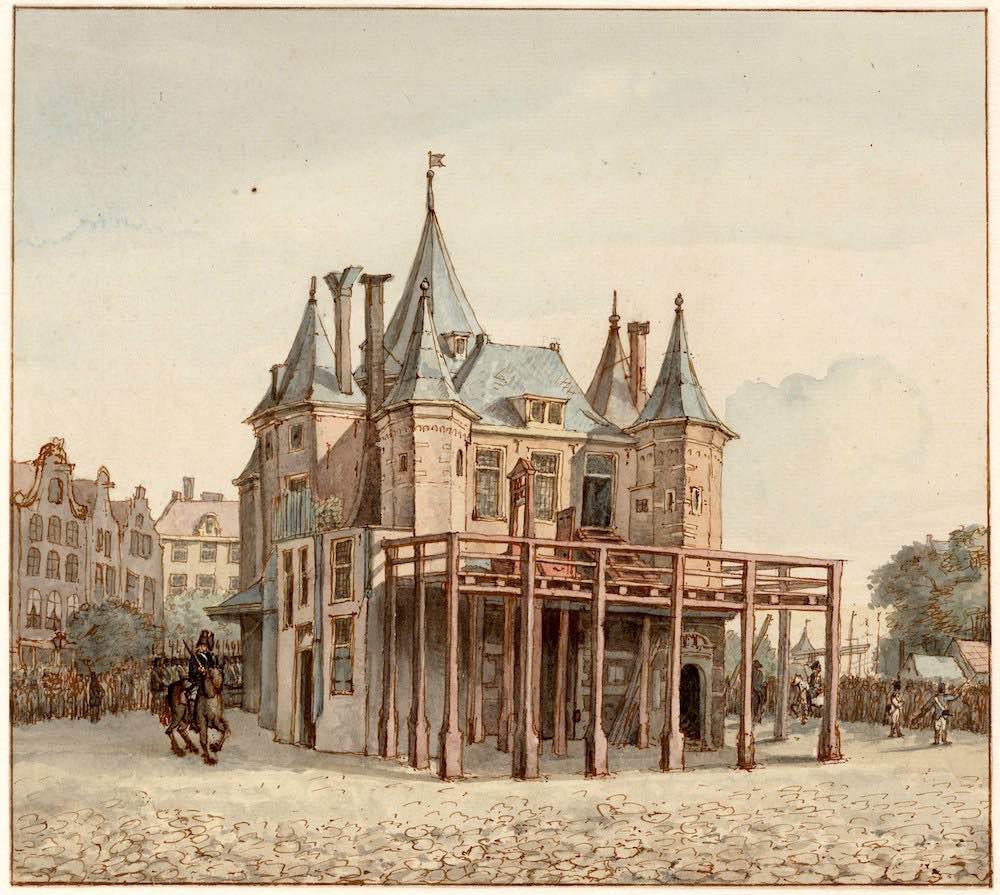
The Nieuwmarkt seen from the south with in the middle The Waag with the scaffold and the guillotine. In the background spectators, who are kept at a distance on horseback by the guard. This is the first and only time that the death penalty was carried out by guillotine in Amsterdam.
The executed were poison mixer Hester Rebekka Nepping, her lover Gerrit Verkerk and housemaid Adriana van Rijswijk. This is a dark chapter, but it shows how public the square once was in both trade and punishment.

The Nieuwmarkt with the Sint Antonieswaag, during the execution of the poison mixer Hester Rebecca Nepping and her accomplices Adriana van Rijswijk and Gerrit Verkerk on June 15, 1812.
No longer a weigh house | 1819

In 1819, a chest of indigo was the last item to be weighed in St. Anthony’s weigh house. The Waag was no longer to be a weigh house. A number of important changes had already been made during the period of French rule in the Netherlands.
The militia and the guilds, for instance, were abolished at the end of the eighteenth century. That meant the building had to find new roles.

Nieuwmarkt Square with The Waag in the background between 1867 and 1883.
Throughout the nineteenth century The Waag had different tenants, including the city fencing masters, the cholera commission and a furniture manufacturer. From 1874 to 1888 The Waag even operated as a fire station.

After that the City Archives were housed in it until 1914. That long line of reuse is one big reason the building survived.

Amsterdam, 1916. Vintage market on Nieuwmarkt Square.
The Waag as Museum and Landmark Today
The Waag As A Museum | 1926

Amsterdam, Nieuwmarkt, 1925 (source: Stadsarchief Amsterdam)
The Waag began to function as a museum in 1926 when the Amsterdam Historical Museum was accommodated there. In 1932 the Jewish Historical Museum moved into one of the tower rooms.
In 1943, during the Second World War, the museum was forced to close and the museum pieces were taken away to Germany. They were found after WWII, and the museum opened in 1955 on the top floor of the Waag.
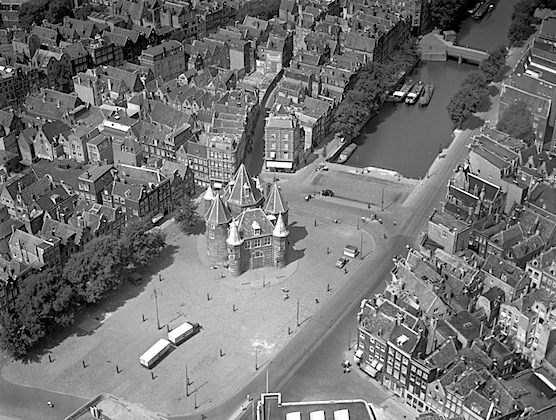
Amsterdam, 9 July 1950. The Waag and Nieuwmarkt from above.
In 1974, the Amsterdam Historical Museum moved to another building, and in 1987 the Jewish Historical Museum followed suit. Another new chapter began for the Waag; one of vacancy, a number of failed initiatives for a new purpose, and renovations.
The Waag Today | > 1996
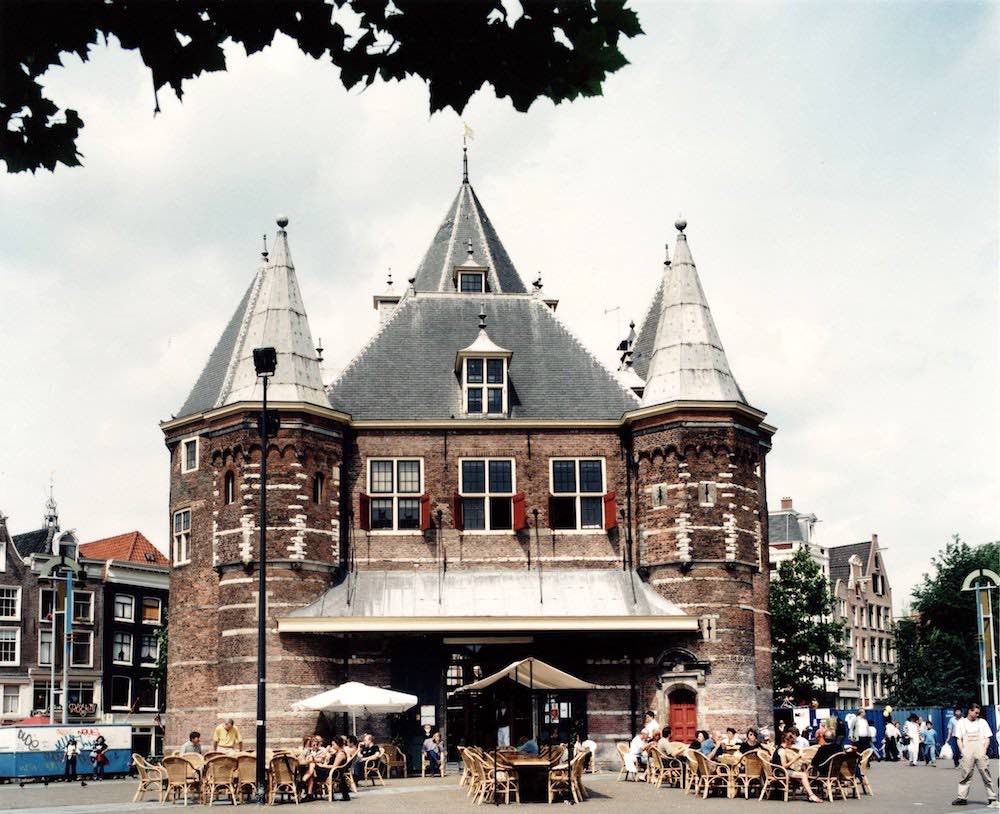
The Waag during the summer of 1998. Source: Stadsarchief Amsterdam/ Alberts, Martin)
Since 1996, after the restoration of the building, the upper floors have been used by Waag Futurelab. The ground floor is home to Restaurant-Café In de Waag, so visitors can still step inside the building today.
The Waag Restaurant Amsterdam
Restaurant Cafe in de Waag occupies the ground floor. We would definitely recommend to go to this restaurant. They offer great food, delicious coffee, tasteful Dutch beers and great wines. All reasonable priced.
Enjoy your lunch or dinner while sitting in the oldest non-religious building of Amsterdam. That is one of the best things about visiting this part of the city: history is not locked away here. You can sit inside it.
Recent research has shown that the building is subsiding unevenly, which could potentially tear The Waag apart. In fact, in the Masons Tower, this formation of cracks has already begun. The current restoration of the foundation was therefore unavoidable. It will provide the age-old, monumental and striking The Waag with a new future.

| What to do here today | Why it helps |
|---|---|
| Walk around Nieuwmarkt | Best way to understand the building’s position in the square |
| Go inside for coffee or lunch | You experience the monument from within |
| Combine it with Zeedijk and Geldersekade | Easy historic walking route |
| Use a pass for other sights | Useful for a full Amsterdam day |
If you want to combine Nieuwmarkt with museums, a canal cruise, and other major sights, compare the Amsterdam Pass. It can save time if you plan to visit several attractions on the same trip.
You can also check the Amsterdam Pass here if you want one booking option for multiple city highlights.
The Waag, Nieuwmarkt, and Evening Amsterdam
The Waag sits in one of the best walking areas in the old centre. After exploring Nieuwmarkt in daylight, many visitors continue toward the Red Light District, Zeedijk, and the canals around Oudezijds Achterburgwal.
If you want to connect history with nightlife, this is a good place to do it. Nieuwmarkt gives you medieval Amsterdam first. Then, a short walk away, you reach the entertainment side of the city. One popular evening stop nearby is Moulin Rouge Amsterdam, which fits naturally into a night route through the old centre after visiting The Waag and surrounding streets.
- Day: architecture, market square, canals, history
- Evening: bars, lights, nightlife, entertainment
- Best combo: Nieuwmarkt → Zeedijk → Red Light District → evening show
FAQ About The Waag
- What is The Waag in Amsterdam?
The Waag is a historic landmark on Nieuwmarkt Square. It began as a medieval city gate (St. Anthony’s Gate) and later became Amsterdam’s weigh house. - Where is The Waag located?
The Waag is on Nieuwmarkt Square (Nieuwmarkt) in central Amsterdam. - How old is The Waag?
The Waag is first mentioned in a deed from 1466, and it may be even older. - Was The Waag originally a gate or a building?
It was originally St. Anthony’s Gate, part of Amsterdam’s medieval defenses. It later became a free-standing building after the city wall was demolished. - Why is The Waag famous?
It’s widely known as Amsterdam’s oldest non-religious building and for its long history as a gate, weigh house, and guild building. - When did The Waag become a weigh house?
The conversion to a weigh house took place around 1617–1618, to reduce pressure on the older weigh house on Dam Square. - What happened at The Waag when it was a weigh house?
Merchants had to weigh goods over fifty pounds, pay fees, and have items inspected. A wide range of goods—like metals, beer, hides, and even anchors—were weighed there. - What are the “guilds” connected to The Waag?
During the weigh-house conversion, the top floor and towers were used by the town militia and multiple guilds. The tower names still reflect guilds like painters, masons, surgeons, and blacksmiths. - What is the Theatrum Anatomicum in The Waag?
In 1690–1691, a dome-shaped hall was built inside The Waag as the Theatrum Anatomicum, where surgeons’ guild professors taught theory classes. - Were anatomy lessons really held there?
Yes. Public anatomical lessons were held there a few times per year, and anatomical education in The Waag continued until 1869. - Was Nieuwmarkt an execution site?
Yes. Under King Louis Bonaparte, Nieuwmarkt was designated as an execution site, and the page records the only guillotine execution in Amsterdam in 1812. - When did The Waag stop being a weigh house?
In 1819, a chest of indigo was recorded as the last item weighed there, after which the Waag was no longer used as a weigh house. - What was The Waag used for after the 1800s?
It had many tenants, including a cholera commission and a furniture manufacturer, and it even served as a fire station. Later, the City Archives were housed there until 1914. - Was The Waag a museum?
Yes. It began functioning as a museum in 1926 when the Amsterdam Historical Museum moved in, and later the Jewish Historical Museum also used one of the tower rooms. - Can you go inside The Waag today?
Yes. The ground floor is used by Restaurant-Café In de Waag, while the upper floors are used by Waag Futurelab.
Also Read
Amsterdam Red Light District History
35 Fun Things To Do In Amsterdam





-
- Home
- Tours
- Hotels
- Información
- Historia
- FAQ
- Contact
- Privacy Policy
Sitemap
-
- Coffeeshops
- Restaurants
- Sex Clubs
- Museums
- Canal Cruises
- Bike Rental
Entertainment
-
Contact


© 2010–2026 Amsterdam Red Light District – Amsterdam Red Light District Travel Guide. Webdesign by BIRO.
 ES
ES  EN
EN  DE
DE  FR
FR  NL
NL  ZH
ZH