


Amsterdam Fun Facts That Will Blow Your Mind
Amsterdam fun facts: 18 surprising facts you should know
Amsterdam fun facts are more interesting when they help you understand the city, not just collect trivia. This guide focuses on the facts that actually explain why Amsterdam feels different from other European capitals.
Last updated: 3 April 2026
If you want the short answer, here it is: Amsterdam is famous for canals, bikes, tolerance, trade history, and a city center where old buildings, nightlife, and daily local life still sit side by side. That mix is what makes the city memorable.
During our time in Amsterdam, we noticed that the best facts are the ones you can still see with your own eyes. The canals are still busy. The bike traffic is still intense. The old church still stands in the middle of the Red Light District. And the city still carries traces of trade, protest, migration, and nightlife in the same streets.
| Quick fact | Why it matters |
|---|---|
| Amsterdam is a city of water | Water covers about 35% of the city’s surface |
| The canal ring is world famous | It is part of Amsterdam’s historic identity and UNESCO value |
| Tourism is huge | Visitor pressure shapes daily city life and local policy |
| The city is strongly LGBTQI+ linked | It has major milestones like the Homomonument and same-sex marriage history |
| Trade shaped Amsterdam | The city helped build the modern stock market |
If you want to combine a canal view with a major museum in one booking, this canal cruise and Van Gogh Museum combo is a useful option. It fits this page well because both the canals and the museum world are part of what makes Amsterdam so recognizable.
1 | Amsterdam is shaped by water
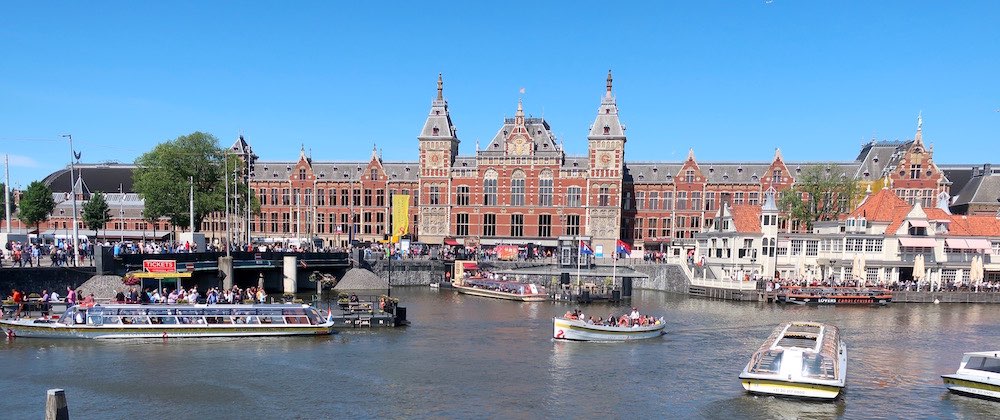
One of the most useful Amsterdam fun facts is also one of the clearest. Amsterdam is a real city of water. The City of Amsterdam says water covers roughly 35% of its surface area. That helps explain why canals, bridges, boats, and waterfront views feel so constant here. Source: City of Amsterdam water policy
Definition: a canal is a man-made waterway used for transport, drainage, or city planning. In Amsterdam, canals were never just decoration. They helped build the city’s economy, shape neighborhoods, and control water in a very low-lying landscape.
The city’s canal belt is so important that it became a UNESCO World Heritage site. That is not just because it looks pretty. It is because the canals are part of a planned urban system that helped Amsterdam grow into a major trading city. Source: UNESCO canal district file
During our walks in the center, we noticed something simple but important: the canals are not background scenery. They shape how you move, where you stop, and what each neighborhood feels like. That is why visitors often remember Amsterdam as much by its water as by its buildings.
- Water covers about 35% of the city surface
- The canal ring is UNESCO-listed
- Canals helped with transport, trade, and water control
- Boat tours carry millions of passengers each year
If you want to experience this side of the city more directly, the canal-museum combination above is practical because it connects two of Amsterdam’s strongest identities: water and art. You can compare that option here: Amsterdam canal cruise + Van Gogh Museum.

2 | Tourism changes the city every year
A very useful fact about Amsterdam is how strongly tourism affects daily life. The city’s own visitor forecast says day visits are expected to move toward around 27 million a year by 2026. That helps explain why crowded streets, busy stations, and visitor rules are such a big topic in Amsterdam. Source: Amsterdam tourism forecast 2024–2026
This matters because tourism is not only about hotels and museums. It affects transport, noise, waste, housing pressure, public behavior, and how the city decides to manage its center.
Definition: day visitors are people who come into the city without staying overnight. They are counted differently from overnight tourists, but they still shape crowd levels and pressure on public space.
During our visits, we noticed that this pressure is easiest to feel in places like Dam Square, Central Station, and the Red Light District. Those places can feel very different depending on the day, the hour, and the season.
| Tourism fact | Why it matters |
|---|---|
| Day visits may approach 27 million by 2026 | Shows how much visitor pressure the city manages |
| Tourism supports many jobs | It is a big part of Amsterdam’s economy |
| Busy areas need stricter rules | Helps explain local regulations and enforcement |
One result of this is that smart visitors often do better by going a little earlier, walking more, and mixing famous stops with calmer neighborhoods. That is not only nicer for you. It is also better for the city.
3 | Amsterdam has deep LGBTQI+ history
Amsterdam is often seen as one of Europe’s most LGBTQI+-friendly cities, and that reputation is rooted in real history. The city’s LGBTQI+ milestones include the Homomonument, unveiled in 1987, which is widely described as the world’s first memorial to gay and lesbian people killed in World War II and to others persecuted because of their sexuality. Source: I amsterdam LGBTQI+ history
That leads to another common question: what is the pink triangle in Amsterdam? It refers to the shape of the Homomonument. The monument is built from three interconnected pink triangles. The pink triangle itself recalls the symbol once used to mark homosexual prisoners during Nazi persecution, and Amsterdam turned that symbol into one of remembrance and resistance. Source: Homomonument design
Another major milestone came in 2001, when the Netherlands became the first country in the world to legalize same-sex marriage. The first same-sex marriages took place in Amsterdam. Source: I amsterdam LGBTQI+ milestones
During our time in the city, we noticed that this history is not hidden. Rainbow flags, Pride references, and open support appear in many neighborhoods, not only in one “designated” zone.
- The Homomonument opened in 1987
- It is built from three connected pink triangles
- Amsterdam hosted the first same-sex marriages in 2001
- The city remains a major LGBTQI+ meeting place

4 | The city mixes religion, trade, and nightlife in one center
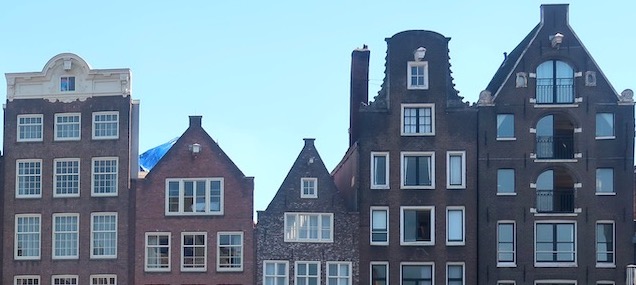
One of the more surprising Amsterdam fun facts is how closely very different parts of city life sit together. In the old center, you can find medieval churches, canal houses, brothels, bars, museums, and monuments all within a short walk.
This is not random. Amsterdam grew through trade and tolerated many groups, but often in layered and practical ways. That helps explain why the city can feel both liberal and deeply historical at the same time.
A good example is the Oude Kerk, the city’s oldest building, standing in the middle of the Red Light District. Another is Ons’ Lieve Heer op Solder, a hidden Catholic church inside a canal house. These places are not side notes. They show how religion, daily life, and city politics overlapped in Amsterdam for centuries.
During our walks through the old center, we noticed that this contrast is one of the main reasons visitors find Amsterdam so memorable. You turn one corner and see a church tower. You turn another and find bars, red-lit windows, or late-night entertainment.
If you want to understand one part of that nightlife better before going, our Moulin Rouge de Ámsterdam. is a helpful next read. It gives clear context on one of the city center’s best-known adult venues and helps visitors decide whether it suits their evening plans.
| Place | What it shows |
|---|---|
| Oude Kerk | Amsterdam’s oldest building in the middle of De Wallen |
| Ons’ Lieve Heer op Solder | A hidden church inside a canal house |
| Barrio Rojo | The city’s layered mix of tourism, nightlife, and history |
5 | Bikes matter, but tourists should still be careful
Amsterdam is famous for cycling, and many people repeat the line that the city has more bikes than residents. The bigger point is this: bikes strongly shape how Amsterdam works, and visitors need to respect that.
The city itself warns that tourist confusion about cycling rules can create dangerous situations for both residents and visitors. That means a fun fact quickly becomes a useful safety fact. Source: Amsterdam Bike City
Definition: a cycle path is a dedicated lane or route for bicycles. In Amsterdam, these are not decorative. They are active transport lanes, and stepping into one without looking can cause accidents.
During our time in Amsterdam, we noticed that many visitors pay attention to cars but forget bikes. That is often the real mistake. The city moves quickly on two wheels, especially around Central Station, Damrak, and busy nightlife streets.
- Look both ways before crossing bike lanes
- Do not stop suddenly in cycle paths
- If you rent a bike, learn the basic rules first
- Busy center streets often feel more bike-heavy than car-heavy
This matters because a city can be both beautiful and fast-moving. Amsterdam is exactly that. A little awareness makes the visit much smoother.
6 | What is the number one crime in Amsterdam?
If you ask this as a visitor question, the most useful answer is pickpocketing. Official visitor safety advice for Amsterdam repeatedly warns about pickpockets in crowded places like cafés, bars, restaurants, transport hubs, and major events. Source: I amsterdam safety and crime
That does not mean Amsterdam is uniquely unsafe. It means the most common problem tourists are likely to run into is theft of phones, wallets, or bags in crowded areas.
Definition: pickpocketing is the theft of money or valuables directly from a person’s pocket, bag, or clothing without them noticing right away.
During our walks in the busiest parts of the center, we noticed the risk is highest when people are distracted. That usually happens at terraces, while taking photos, when checking maps, or when someone creates a small distraction.
| Risk area | Why it matters |
|---|---|
| Central Station | Large crowds and distracted arrivals |
| Dam Square | Heavy foot traffic and tourists taking photos |
| Bars and cafés | Phones and bags often left loose |
| Major events | Crowding makes theft easier |
The simple rule is this: keep your phone and wallet close, especially in dense crowds. That is one of the easiest ways to avoid trouble in the city center.
7 | More useful Amsterdam fun facts
Some facts are still worth keeping because they help explain the city fast. Amsterdam is home to the world’s first stock exchange tradition, it has the famous nickname Mokum, and it continues to mix trade, tourism, nightlife, and local life in a very compact center.
The city is also strongly tied to art and architecture. Central Station and the Rijksmuseum were both designed by Pierre Cuypers, which helps explain why they feel visually connected even though they serve very different purposes.
During our visits, we found that the most memorable “fun facts” are usually the ones that lead to a place you can actually go. That is why canal facts, LGBTQI+ history, the old center, and safety tips are more useful than random trivia.
- Mokum is a well-known nickname for Amsterdam
- The city helped shape the modern stock market
- The canal belt is globally famous for a reason
- Tourism changes the city, but local life is still visible if you look for it
People Also Ask
1 | What is Amsterdam known for?
Amsterdam is known for canals, bikes, major museums, old architecture, nightlife, and its open but layered social history. It is also known for Anne Frank, the Rijksmuseum, the Van Gogh Museum, and the Red Light District.
2 | What makes Amsterdam unique?
The city’s uniqueness comes from the mix. Water, trade history, tolerance, nightlife, old churches, modern crowds, and neighborhood life all sit close together in the center.
3 | What is the nickname for Amsterdam?
Mokum is a long-used nickname for Amsterdam. It comes from a Hebrew word meaning place.
4 | What is the pink triangle in Amsterdam?
It refers to the Homomonument, made from three interconnected pink triangles. It is a memorial to people persecuted because of their sexual orientation and is one of the most important LGBTQI+ landmarks in the city.
5 | What is the number one crime in Amsterdam?
For visitors, the most common crime concern is pickpocketing, especially in crowded places like stations, cafés, and busy tourist zones. Source: visitor safety advice
More Amsterdam Fun Facts?
If you want more context than a normal list can give, the Amsterdam Audio Tours app is a good next step. It adds real stories, GPS guidance, pictures, and local background so the city starts to make more sense instead of feeling like a set of disconnected sights.
Listen to it at home like a podcast or use it while walking in the Red Light District. It is especially useful if you want history, local context, and facts that connect to real streets and buildings.
GET THE APP >Also read:
15x Things To Do in Amsterdam Red Light District
13x Amsterdam Red Light District Facts




-
- Home
- Tours
- Hotels
- Información
- Historia
- FAQ
- Contact
- Privacy Policy
Sitemap
-
- Coffeeshops
- Restaurants
- Sex Clubs
- Museums
- Canal Cruises
- Bike Rental
Entertainment
-
Contact


© 2010–2026 Amsterdam Red Light District – Amsterdam Red Light District Travel Guide. Webdesign by BIRO.
 ES
ES  EN
EN  DE
DE  FR
FR  NL
NL  ZH
ZH